

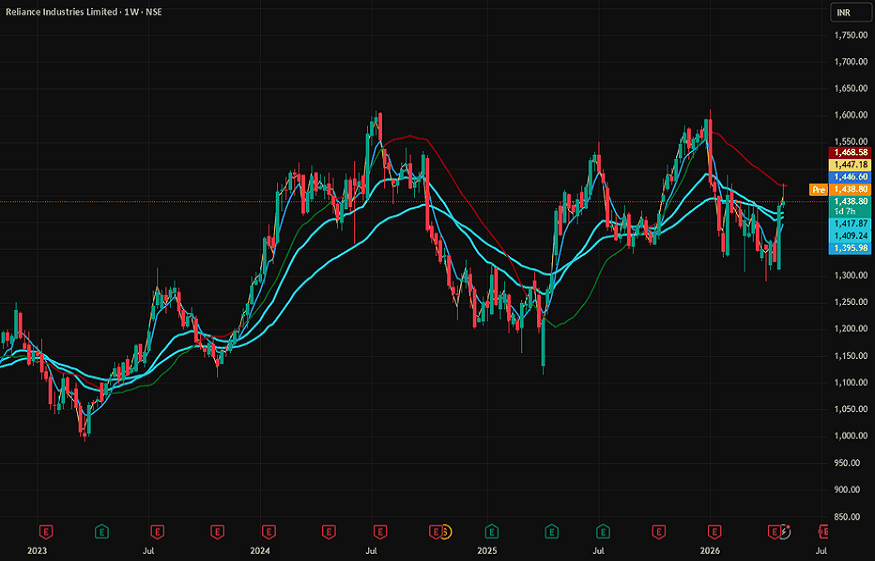
There is a quiet discipline that separates consistently profitable traders from those who struggle through every market cycle. It does not lie in chasing tips or reacting to headlines — it lives in the ability to read market structure before the crowd catches on. Index futures have long served as the first morning ritual for participants who track institutional positioning, and those who follow Nifty Futures understand that these contracts carry the fingerprints of smart money on a daily basis. Stock-specific derivatives tell a different story — one that is both more concentrated and more revealing about sectoral sentiment. Traders who study the Reliance Option Chain, for instance, gain access to a window into how the market is pricing risk around one of the most heavily weighted and widely tracked companies on the National Stock Exchange. When both layers of information are read together with discipline and context, a trader’s decision-making improves substantially.
Why Single-Stock Derivatives Tell a Different Story
Index derivatives aggregate the behaviour of fifty or more companies, which means individual corporate events get diluted within the broader noise. Single-stock derivatives, by contrast, are acutely sensitive to company-specific triggers — quarterly earnings, management commentary, regulatory developments, capacity announcements, and changes in promoter holding.
Read More : Loan for Travel: A Smart Way to Fund International Trips Without Draining Savings
This sensitivity makes single-stock option chains both more rewarding and more dangerous than their index counterparts. The premium structures tend to be wider, liquidity can dry up quickly in far out-of-the-money strikes, and implied volatility often spikes aggressively ahead of results. A trader approaching individual stock derivatives without understanding these dynamics is operating in territory far more unforgiving than the index space.
The key is preparation — studying not just where open interest sits, but why it is positioned there, and what event on the corporate calendar might be responsible for that build-up.
Reading Open Interest Shifts on High-Conviction Days
Open interest data becomes most meaningful not in isolation, but in the context of how it changes from one session to the next. A sudden surge in call open interest at a specific strike, without a corresponding rise in premium, often suggests that traders are writing covered calls or hedging long equity positions — not expressing directional bearishness. Understanding this distinction prevents costly misinterpretations.
Conversely, when put open interest builds sharply at strikes close to the current market price and is accompanied by rising premium, it signals genuine concern about downside risk among participants who are willing to pay up for protection. This kind of defensive positioning ahead of a major corporate announcement is a reliable signal that large participants are not comfortable holding unhedged long positions into the event.
Watching how this positioning evolves over two to three sessions before a known catalyst gives traders a meaningful probabilistic edge.
The Relationship Between Futures Premium and Spot Movement
Futures pricing shows the collective expectation of where a stock or index will trade through the expiration date of the contract. The difference between the futures payment and the spot rate — known as the complex — a brilliant near-term deal often speaks to market sentiment.
When futures consistently reverse a healthy peak rate, it indicates that individuals are willing to pay more for a destiny delivery — a signal to bullish belief that when this peak rate falls or becomes a discount, it often raises the sustainability of any ongoing rise. Quick buyers who forget about foundation business usually discover themselves caught in reversals that more knowledgeable members had already anticipated and positioned for.
Monitoring daily changes in the future open interest alongside the fund movement is a simple yet effective dependency that pays no fees and can prevent an unprecedented settlement of unnecessary losses.
Implied Volatility as a Risk Thermometer
Every option carries within its price an implied expectation of how much the underlying asset might move before expiry. This implied volatility is not a directional indicator — it does not tell you whether the stock will go up or down. What it does tell you is how much movement the market is pricing in, and at what cost.
Read More : Business Setup in Dubai with Integrated Estate Planning
When implied volatility is elevated, option premiums are expensive. Buying options in such environments requires a much larger price move to generate profit, because a significant portion of the premium paid is composed of volatility expectations that may deflate sharply once the triggering event passes. Selling options when volatility is high can be rewarding, but must always be done with defined risk through spreads or hedges.
Combining Both Data Sets to Build a Coherent Trading View
Markets do not move in isolation. When the broader index shows strong institutional buying in futures alongside supportive technical structure, and a heavyweight stock simultaneously shows put writing activity at lower strikes — indicating that large traders are comfortable selling downside protection — the combined picture is one of underlying strength.
Building this kind of layered analysis takes time, consistency, and a commitment to studying market structure beyond candlestick patterns. But once internalised, it becomes second nature — and the quality of trading decisions improves in ways that no single indicator ever could achieve alone.